Option Moneyness Explained: ITM, ATM & OTM with Examples
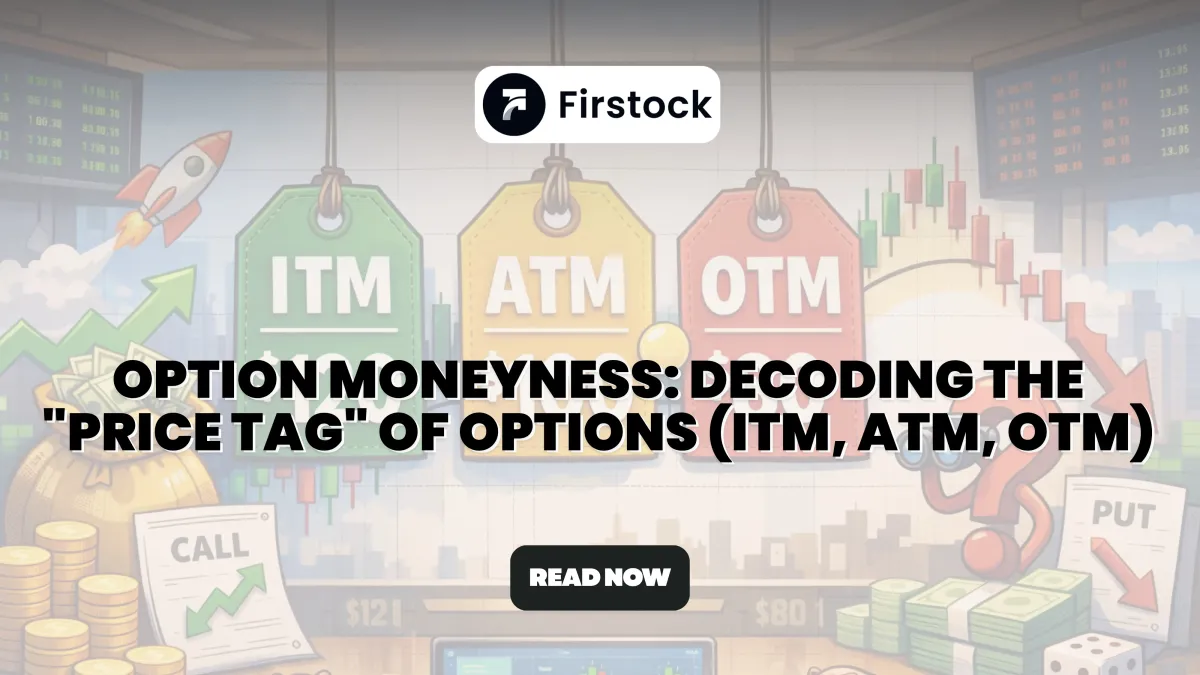
Option Moneyness Explained: What Is Moneyness in Options & How Professionals Use It
When traders open an option chain on Firstock - Trading App , they often feel overwhelmed.
Hundreds of strike prices.Some options cost ₹5.Some cost ₹200.Some are priced above ₹1,000.
Most beginners ask the wrong question:👉 “Which option is cheap?”
Professionals ask the right one:👉 “What is the moneyness of this option?”
That single concept — option moneyness — decides whether an option has real value, false hope, or pure probability.
In this in-depth guide, you will understand what is moneyness in options, how the moneyness of options affects pricing, probability, and risk, and how professional traders use ITM, ATM, and OTM strategically instead of emotionally.
Quick Definition
Option moneyness describes the relationship between an option’s strike price and the current market price (spot price) of the underlying asset.It determines whether an option is In The Money (ITM), At The Money (ATM), or Out of The Money (OTM).
Why Option Moneyness Is the Foundation of Options Trading
Most option traders don’t lose money because they are wrong about market direction.They lose because they choose the wrong strike price.
That mistake happens when traders ignore moneyness in options and focus only on:
- Cheap premiums
- Big percentage returns
- Expiry-day excitement
Moneyness tells you:
- Whether an option has intrinsic value
- How fast it will move (delta)
- How fast it will decay (theta)
- The probability of profit
Once you understand this, option chains stop looking confusing — they start looking logical.
What Is Moneyness in Options?
Simply put, moneyness answers one critical question:
“If I exercised this option right now, would I make money?”
Based on the answer, every option contract falls into three states of moneyness:
- In The Money (ITM) – has real value now
- At The Money (ATM) – closest to the current price
- Out of The Money (OTM) – has zero real value now
This classification applies to both Call and Put options.
Understanding the 3 States of Option Moneyness (With Nifty Example)
Assume Nifty is trading at 24,000.
1. In The Money (ITM)
Definition:An option is In The Money when it already has intrinsic value.The strike price has already been crossed by the market.
Call Option (ITM):
- Nifty at 24,000
- 23,800 Call → ITM
Put Option (ITM):
- Nifty at 24,000
- 24,200 Put → ITM
Characteristics of ITM Options:
- Higher premiums
- High delta (moves closely with price)
- Lower time decay risk
- Higher probability of profit
Trader Psychology:ITM options feel “expensive” but are actually safer.
2. At The Money (ATM)
Definition:ATM options have strike prices closest to the current market price.
Example:
- Nifty at 24,000
- 24,000 CE and 24,000 PE
Characteristics of ATM Options:
- Maximum liquidity
- Delta around 0.50
- Highest gamma (fast price changes)
- Highest time value
Why Professionals Love ATM:This is where institutions hedge, algos operate, and volatility explodes.
3. Out of The Money (OTM)
Definition:OTM options have zero intrinsic value and depend entirely on future movement.
Call Option (OTM):
- 24,500 Call
Put Option (OTM):
- 23,500 Put
Characteristics of OTM Options:
- Cheap premiums
- Low delta (slow movement)
- High time decay
- Low probability of profit
OTM options are often called “lottery tickets” — cheap, exciting, and usually worthless at expiry.
The Option Moneyness Formula (The Truth Behind Premiums)
Option Premium = Intrinsic Value + Time Value
Let’s calculate this with Nifty @ 24,000:
Key Insight:
- ITM = real value + hope
- ATM = pure hope
- OTM = 100% hope
This is why OTM options decay the fastest.
Option Moneyness & Probability of Profit (POP)
Moneyness is essentially a probability calculator.
Amateurs: chase returnsProfessionals: chase probability
That’s why experienced traders prefer:
- Buying ITM or ATM
- Selling OTM options
Real-World Case Study: The “Cheap Option” Trap
Scenario:Nifty moves from 24,000 → 24,100 (+100 points)
Trader A – The Professional
- Buys 24,000 CE (ATM) at ₹100
- Delta ≈ 0.50
- Option moves to ₹150
- Profit: ₹50 (50%)
Trader B – The Gambler
- Buys 24,300 CE (OTM) at ₹20
- Delta ≈ 0.20
- Strike still far away
- Option barely moves
- Profit: Near zero
Lesson:Correct direction + wrong moneyness = loss.
Strike Selection Matrix: Which Moneyness to Choose?
The Moneyness Lifecycle (Most Traders Ignore This)
Moneyness changes continuously:
- OTM → ATM → ITM (market moves up)
- ITM → ATM → OTM (market moves down)
⚠️ Danger Zone:When an option enters the ATM zone, volatility spikes violently.
Pro Tip:If your OTM option suddenly becomes ATM, manage aggressively — book profits or hedge.
Option Moneyness & Option Greeks (Advanced Insight)
This is why:
- ATM options explode near breakouts
- OTM options melt near expiry
Why Professionals Avoid Buying Cheap Options
OTM options look cheap for a reason.
They:
- Depend on perfect timing
- Lose value rapidly
- Expire worthless most of the time
Consistent traders don’t chase excitement — they build probability.
Final Conclusion: Moneyness Separates Traders from Gamblers
If you understand option moneyness, you understand:
- Strike selection
- Risk management
- Probability-based trading
Stop buying options because they are cheap.Start buying or selling options because the moneyness makes sense.
That’s how consistency is built.
Next Step:
Log in to Firstock - Discount Broker right now. Open the Nifty Option Chain. Look for the "Delta" column. Compare the Delta of an ATM strike (0.50) vs. a Far OTM strike (0.10) to see exactly how much "speed" you are losing by going cheap!
Frequently Asked Questions
1. What is option moneyness in simple words?
It shows whether an option is profitable right now based on strike price vs market price.
2. Which moneyness is best for beginners?
ATM or slightly ITM options due to balanced risk and liquidity.
3. Why do OTM options expire worthless?
Because they have no intrinsic value and depend entirely on future price movement.
4. Is moneyness more important than direction?
Yes. Wrong moneyness can cause losses even with correct direction.
5. Do professional traders use moneyness?
Yes. Institutions, option sellers, and algorithms rely heavily on moneyness.
6. Why are ATM options most liquid?
Because they are used for hedging, speculation, and institutional positioning.
Disclaimer:This content is for educational purposes only and should not be considered investment or trading advice.