Synthetic Futures Strategy: Synthetic Futures Contract | 2026
Synthetic Futures: How Options Replicate Futures Positions
You want to trade the Nifty index. You look at the futures contract, but the margin requirements are massive, or maybe it is trading at a heavy and unreasonable premium to the spot price. Most retail traders either swallow the cost or walk away. Professional traders do neither.
They build their own contract.
They use the options market to create a synthetic futures contract that behaves exactly like the real thing, often with better pricing dynamics and more flexibility.
This is one of the most powerful concepts in advanced derivatives trading. By understanding synthetic futures, traders can replicate futures positions using options, bypass inefficient pricing, and unlock new opportunities in the options market.
Here is the "Enough Thinking" guide to understanding synthetic futures, synthetic future strategy techniques, and synthetic futures contracts, including how to build them and why they are a crucial weapon in professional trading.
What is a Synthetic Futures Contract?
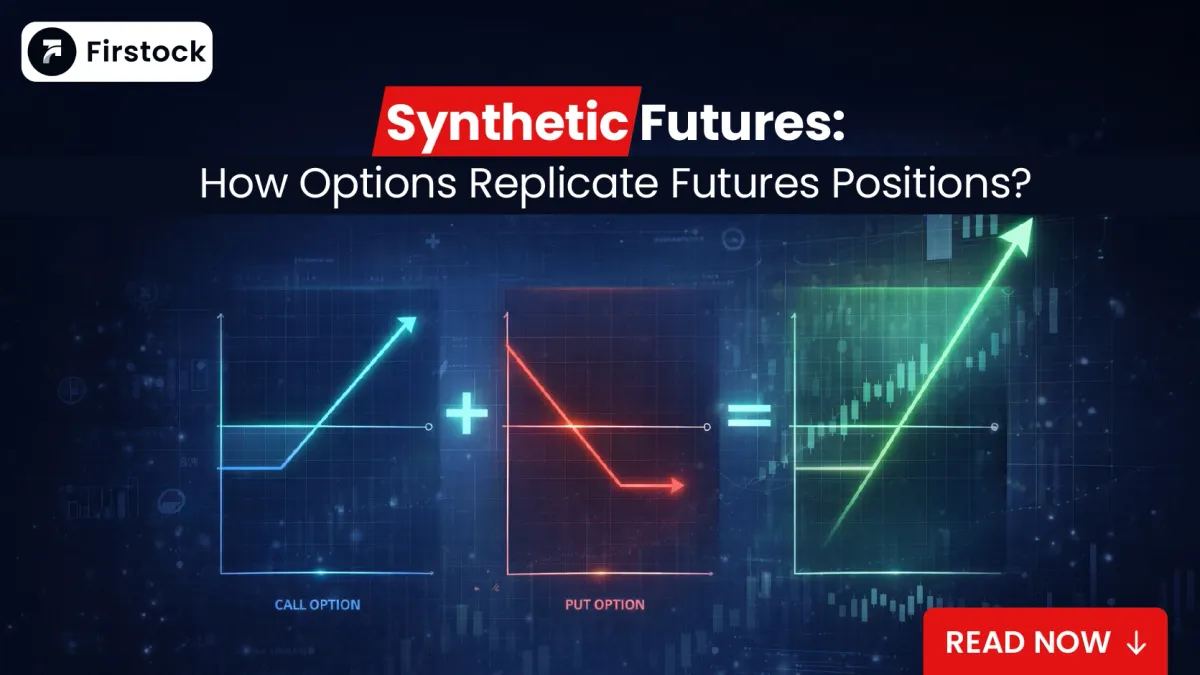
A synthetic future is an options position that mimics the exact mathematical payoff of a traditional futures contract.
Whether the market goes up 100 points or drops 100 points, your profit or loss on the synthetic position will be practically identical to holding the actual future.
In simple terms:
A synthetic futures contract replicates the payoff structure of a futures contract using options.
You create it by combining Call and Put options at the same strike price and the same expiration date.
This relationship comes from one of the most important mathematical rules in options pricing known as Put-Call Parity.
Put-Call Parity Formula
C + X/(1+r)^t = P + S
Where:
- C = Call Option Price
- P = Put Option Price
- S = Spot Price
- X = Strike Price
- r = Interest Rate
- t = Time to Expiry
By rearranging the variables in this equation, traders can replicate the underlying asset entirely using options contracts.
This mathematical principle is what makes synthetic futures contracts possible.
Professional traders, hedge funds, and arbitrage desks use this relationship every day to exploit price differences between options and futures markets.
Why Synthetic Futures Matter in Options Trading
Synthetic futures strategies are important because they allow traders to recreate futures exposure using options positions.
This provides multiple advantages:
- Avoid overpriced futures contracts
- Create arbitrage opportunities
- Gain more flexibility when managing trades
- Access advanced hedging strategies
For example, if the Nifty spot price is 25,000 but Nifty futures are trading at 25,150, traders buying the futures are paying a 150-point premium.
Instead of paying this premium, traders can build a synthetic future strategy using options, which may align closer to the actual spot price.
This is why professional traders frequently compare synthetic futures pricing vs real futures pricing before executing large trades.
1. The Synthetic Long Future (Bullish)
If you are aggressively bullish and want to replicate buying a futures contract, you execute a Synthetic Long Future strategy.
This strategy replicates the payoff of buying a futures contract, giving traders unlimited upside exposure.
The Execution
Buy an At-The-Money (ATM) Call Option AND Sell an ATM Put Option
Both options must have:
- The same strike price
- The same expiry date
The Math Behind Synthetic Long Futures
By buying the Call, you get unlimited upside potential.
By selling the Put, you accept unlimited downside risk.
The premium you pay for the Call is usually offset by the premium received from selling the Put, meaning the trade can often be initiated with very little net premium cost.
Synthetic Long Example
Suppose Reliance stock is trading at ₹3,000.
You create a synthetic future by executing:
- Buy 3000 Call
- Sell 3000 Put
Scenario 1: Price Rises to ₹3,100
Your Call option makes ₹100. Your Put expires worthless.
Total Profit = ₹100
This is exactly the same payoff as holding a futures contract.
Scenario 2: Price Falls to ₹2,900
Your Call expires worthless.
Your short Put loses ₹100.
Total Loss = ₹100
Again, the payoff is identical to a long futures position.
2. The Synthetic Short Future (Bearish)
If you are aggressively bearish and want to replicate shorting a futures contract, you use a Synthetic Short Future strategy.
This strategy replicates the payoff of selling futures.
The Execution
Sell an ATM Call Option AND Buy an ATM Put Option
Same strike price and same expiry.
The Math
Buying the Put allows you to profit when the market falls.
Selling the Call obligates you to cover losses if the market rallies sharply.
This combination produces a payoff structure identical to shorting a futures contract.
Example
Assume Nifty is trading at 25,000.
You execute:
- Sell 25000 Call
- Buy 25000 Put
Scenario 1: Nifty Drops to 24,800
Put profit = 200 points Call expires worthless
Profit = 200 points
This is exactly the same result as shorting Nifty futures.
Scenario 2: Nifty Rises to 25,200
Put expires worthless Short Call loses 200 points
Loss = 200 points
Again identical to short futures.
Why Bother? (The Synthetic Future Strategy)
If a synthetic future behaves exactly like a real future, why go through the trouble of combining two options to build it?
Professional traders rely on synthetic futures strategies for several strategic advantages.
1. Avoiding the "Premium" Tax
Sometimes institutional demand pushes futures prices far above the spot price.
This situation is called Contango.
Example:
Nifty Spot = 25,000 Nifty Futures = 25,150
Buying the futures means you are paying 150 extra points.
A synthetic futures contract built using ATM options stays closer to the spot price.
This allows traders to avoid the inflated futures premium.
2. The Arbitrage Play (Reversal / Conversion)
If the synthetic future is cheaper than the real futures contract, arbitrage traders act immediately.
They execute two simultaneous trades:
- Buy the synthetic future
- Short the actual future
Because both contracts must converge at expiry, this locks in a risk-free arbitrage profit.
Large trading firms run high-speed algorithms to identify these opportunities instantly.
3. Strategic Flexibility
A synthetic futures strategy provides flexibility that real futures contracts do not.
Because synthetic futures involve two option legs, traders can adjust or close one leg independently.
Example:
You hold a Synthetic Long Future:
- Long Call
- Short Put
If the market suddenly crashes, you can close the Short Put to reduce downside risk while keeping the Long Call open.
This flexibility allows traders to dynamically manage risk.
You cannot split a real futures contract this way.
4. Better Pricing Opportunities
Options prices incorporate volatility expectations, while futures pricing incorporates cost of carry.
When volatility spikes, synthetic futures may sometimes offer better pricing than actual futures contracts.
Professional traders constantly compare:
- Futures price
- Synthetic futures price
- Options implied volatility
This comparison helps identify pricing inefficiencies in derivatives markets.
The Hidden Traps
Synthetic futures should never be traded blindly.
Although the payoff resembles a futures contract, the structure involves options, which introduces additional complexities.
Margin Requirements
Selling options requires margin.
Even if the synthetic futures position has almost zero net premium, brokers still require SPAN margin for the short option leg.
This means the margin required for a synthetic future is usually similar to holding a real futures contract.
Modern trading platforms such as Firstock – Trading App allow traders to check margin requirements instantly using margin calculators and options chain tools.
This helps traders understand the capital required before executing complex strategies like synthetic futures.
Liquidity Risk
Actual index futures are usually the most liquid instruments in the market.
However, if you build a synthetic future using options in an illiquid stock, the wide bid-ask spreads can reduce your profitability.
Liquidity problems may cause:
- Slippage
- Difficult trade exits
- Higher transaction costs
Therefore, synthetic futures strategies work best in high-liquidity markets such as Nifty or Bank Nifty options.
Synthetic Futures vs Real Futures
Synthetic Futures vs Synthetic Call Option Strategy
Traders often confuse synthetic futures strategies with synthetic call option strategies.
However, they serve completely different purposes.
Synthetic Futures
Replicates the underlying asset itself.
Risk profile:
- Unlimited profit
- Unlimited loss
Synthetic Call Option Strategy
Replicates the payoff of a Call option.
Built using:
- Buying the underlying stock
- Buying a protective Put option
This creates limited downside risk with unlimited upside potential.
Practical Example: Synthetic Futures in Nifty
Assume Nifty = 25,000
You execute:
Buy 25000 Call Sell 25000 Put
Lot size = 50
If Nifty rises to 25,200:
Profit = 200 × 50
Profit = ₹10,000
This is identical to the profit from buying Nifty futures.
Expiry Day Risks
If synthetic stock options are held until expiry, physical settlement rules apply.
Since one option will be In-The-Money, traders may be forced to:
- Take delivery of shares (Short Put)
- Deliver shares (Short Call)
These obligations can require massive delivery margins.
Most professional traders square off synthetic futures positions before expiry to avoid these complications.
Conclusion
Synthetic futures are one of the most powerful strategies in derivatives trading.
By combining call and put options, traders can recreate the exact payoff of a futures contract while gaining additional flexibility and potentially better pricing.
Professional traders use synthetic futures to:
- Avoid overpriced futures contracts
- Execute arbitrage strategies
- Adjust positions dynamically
- Exploit options pricing inefficiencies
However, synthetic futures also carry significant risks, including unlimited losses and margin requirements.
Understanding the mechanics of synthetic futures contracts, synthetic future strategies, and synthetic call option strategies can give traders a deeper insight into how derivatives markets truly function.
For traders looking to analyze options strategies efficiently, platforms like Firstock – Option Trading App provide tools such as advanced charting, options chain analysis, and strategy builders that help traders evaluate complex positions like synthetic futures.
Used correctly, synthetic futures can become a powerful addition to any advanced options trader's toolkit.
FAQs
1. What are synthetic futures?
Synthetic futures are options strategies that replicate the payoff of a futures contract by combining a call option and a put option with the same strike price and expiry date.
2. How do synthetic futures work?
Synthetic futures work using Put-Call Parity, which mathematically links options prices to the underlying asset price.
By combining call and put options, traders recreate the payoff of futures contracts.
3. What is a synthetic long future strategy?
A synthetic long future strategy involves:
Buy ATM CallSell ATM Put
This replicates buying a futures contract.
4. What is a synthetic short future strategy?
A synthetic short future strategy involves:
Sell ATM Call Buy ATM Put
This replicates selling a futures contract.
5. Is a synthetic futures contract cheaper than real futures?
Sometimes yes.
Synthetic futures may avoid overpriced futures premiums, especially when markets are in contango.
6. What is the difference between synthetic futures and synthetic call option strategy?
Synthetic futures replicate the underlying asset.
Synthetic call strategies replicate call option payoffs with limited risk.
7. Do synthetic futures require margin?
Yes.
Because the strategy involves selling options, brokers require SPAN margin similar to futures trading.
8. Can beginners trade synthetic futures?
Synthetic futures are considered advanced derivatives strategies.
Beginners should first understand options pricing, risk management, and margin requirements before trading them.
Disclaimer: Investments in the securities market are subject to market risks. Read all related documents carefully before investing.