What Is Implied Volatility? Formula & Example | 2026
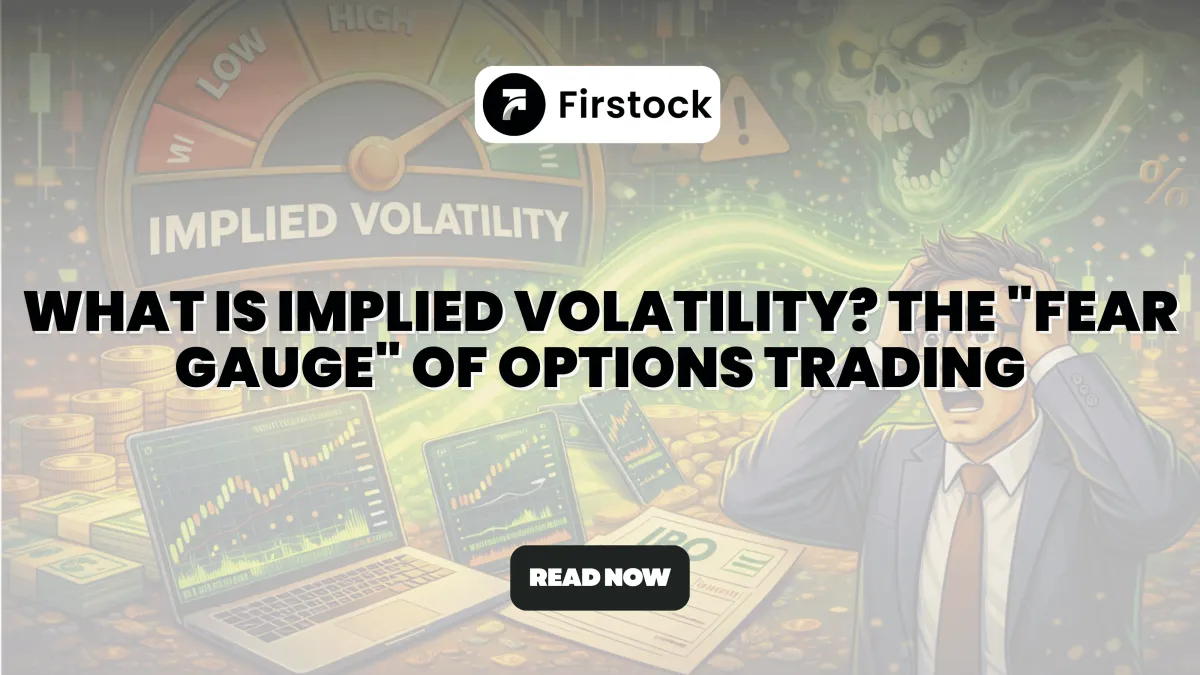
What is Implied Volatility? The "Fear Gauge" of Options Trading
If you have ever bought an option before an earnings result, saw the stock move in your direction, and still lost money, you have been a victim of Implied Volatility (IV).
In this guide, we will break down what is implied volatility, the implied volatility formula, and how to use it to stop losing money on "correct" directional trades.
What is Implied Volatility (IV)?
Implied Volatility, or IV, shows you what the market expects a stock’s future moves to look like. It’s basically the market’s best guess at how wild the ride ahead might get. If you want to know how much a stock actually moved before, that’s Historical Volatility—the rearview mirror. But IV? That’s your windshield. It’s all about what traders think is coming next.
The Golden Rule:
- High IV: The market is "scared" or expecting a massive move (e.g., before Budget, Earnings). Option premiums become Expensive.
- Low IV: The market is "calm" or expecting no movement. Option premiums become Cheap.
Implied Volatility Formula & Logic
While you don't need to calculate IV manually (software does it), understanding the logic is crucial. IV is derived from the Black-Scholes Model by working backward.
Usually, you input variables (Stock Price, Strike, Time, etc.) to find the Option Price.
Option Price = f(Stock Price, Strike, Time, Rates, Volatility)
For IV, we do the reverse. We take the current Option Price trading in the market and ask:
"What volatility number is needed to justify this price?"
Implied Volatility = f(Option Price, Stock Price, Strike, Time, Rates)
Real-World Example:
- Scenario: Nifty is at 24,000. A 24,000 Call usually costs ₹100.
- The Event: It is Budget Day morning. The same 24,000 Call is trading at ₹300.
- Why? The stock price hasn't changed. Time hasn't changed. The only variable that changed is the market's expectation of a big move.
- Result: The IV has spiked, inflating the premium from ₹100 to ₹300.
Implied Volatility vs. Option Prices (The Relationship)
IV is like a balloon pump for premiums.
- IV Expansion (Rising Volatility):
- When IV goes up, BOTH Call and Put prices go up.
- Trader Trap: You might buy a Put thinking the market will crash. If the market stays flat but IV rises (fear increases), your Put will still make money.
- IV Contraction (Crashing Volatility):
- When IV goes down, BOTH Call and Put prices crash.
- The "IV Crush": This happens immediately after a news event (like Earnings). The uncertainty is over, so IV collapses. This is why buying options before results is dangerous.
How to Use IV in Trading?
Stop guessing and start looking at the IV Percentile (IVP) or IV Rank.
1. When IV is Low (IV Percentile < 20)
- Environment: Market is boring/calm. Options are cheap.
- Strategy: Buy Options (Long Call, Long Put).
- Why? You pay very little premium. If the market moves, you profit from Delta. If volatility returns, you profit from Vega.
2. When IV is High (IV Percentile > 80)
- Environment: Market is panic-stricken/expecting news. Options are expensive.
- Strategy: Sell Options (Credit Spreads, Iron Condors).
- Why? You collect fat premiums. Even if the market moves against you slightly, the eventual drop in IV (crush) will cushion your loss or boost your profit.
IV in Options: The "Vega" Connection
The Greek that measures sensitivity to IV is Vega.
- Vega tells you how much your option price will change for a 1% change in IV.
Example:
- Option Premium: ₹100
- Vega: 5
- IV Change: Increases by 2%
- New Premium: $100 + (2 * 5) = ₹110$.
Lesson: Long-term options (LEAPS) have higher Vega. They are more sensitive to IV changes than weekly options.
The "Volatility Smile": Why OTM Options Are Expensive
If you plot the IV of all strike prices on a graph, you won't get a straight line. You will see a curve that looks like a smile or a smirk. This is the Volatility Smile.
- The Reality: In a perfect world (Black-Scholes model), all strikes would have the same IV.
- The Market: In reality, traders are more scared of crashes.
- The Result:
- OTM Puts (Downside): Have Higher IV (The "Smirk"). Traders pay extra for crash protection.
- OTM Calls (Upside): Usually have lower IV, unless it's a "meme stock" expecting a moonshot.
How to Trade It:
- Don't Buy High Skew: Avoid buying Deep OTM Puts for "lottery tickets." You are paying a premium for fear that is already priced in.
- Sell the Skew: Professional traders often sell OTM Puts (Cash Secured Puts) to collect this "fear premium."
IV Rank vs. IV Percentile: Know the Difference
Traders often confuse these two, but they tell different stories.
Weekly vs. Monthly IV: The "Event" Trap
Did you know different expiries have different IVs?
- Scenario: Budget Day is in 3 days (Weekly Expiry).
- Weekly Options: IV will be sky-high (e.g., 60%). The market expects chaos this week.
- Monthly Options: IV might be lower (e.g., 25%). The market thinks the chaos will settle down by month-end.
The Strategy:
If you want to trade the event but avoid the massive IV Crush, trade the Next Month Expiry. The Vega impact will be lower, protecting your capital if the volatility balloon pops too fast.
The "VIX" Correlation: Your Market Barometer
You cannot trade stock options without looking at the India VIX.
- VIX < 12: Complacency. Option buyers get cheap deals, but moves are small.
- VIX 12-18: Normal Market. Good for standard strategies (Spreads).
- VIX > 20: Fear/Panic. Option Sellers' Paradise. Premiums are juicy, but risk is high.
- VIX > 30: Crisis Mode. Cash is king. Avoid leverage unless you are an expert.
Rule of Thumb:
- If you see VIX rising + Nifty falling: Typical panic. Puts will be expensive.
- If you see VIX rising + Nifty rising: Rare! This means traders are buying Calls aggressively (FOMO), leading to a potential blow-off top.
Summary: The IV Checklist
Before you click "Buy" on that Call option:
- Check IV Percentile: Is it under 20 (Buy) or over 80 (Sell)?
- Check the Event Calendar: Is earnings tomorrow? If yes, STOP. You are walking into an IV Crush trap.
- Check the Skew: Are you buying a remarkably expensive OTM Put? Maybe sell a spread instead to offset the cost.
Conclusion: Buy Low (IV), Sell High (IV)
Understanding implied volatility options changes your entire trading game. You stop asking "Where will the market go?" and start asking "Is this option cheap or expensive?"
- Don't buy when IV is at an all-time high (you are buying the top).
- Don't sell when IV is at an all-time low (you are collecting pennies in front of a steamroller).
Frequently Asked Questions (FAQs)
1. Can IV predict the direction of the market?
No. IV predicts the magnitude (size) of the move, not the direction. High IV means a big move is coming, but it could be up or down.
2. What is "IV Crush"?
It is the sudden drop in Implied Volatility after a major event (like earnings or elections) concludes. The uncertainty vanishes, causing option premiums to crash instantly.
3. Does High IV mean high risk?
Yes. High IV implies the market expects a violent range. While this offers high reward potential for buyers, the risk of whipsaws is significant.
4. How is IV different from VIX?
- VIX: Measures the implied volatility of the entire index (e.g., Nifty 50) for the next 30 days.
- Option IV: Measures the implied volatility of a specific strike price on a specific stock.
Disclaimer: The content should not be construed as investment, trading, or personal financial advice.This blog is for educational purposes only.