Why Paper Trading Fails in Real Options Trading | 2026
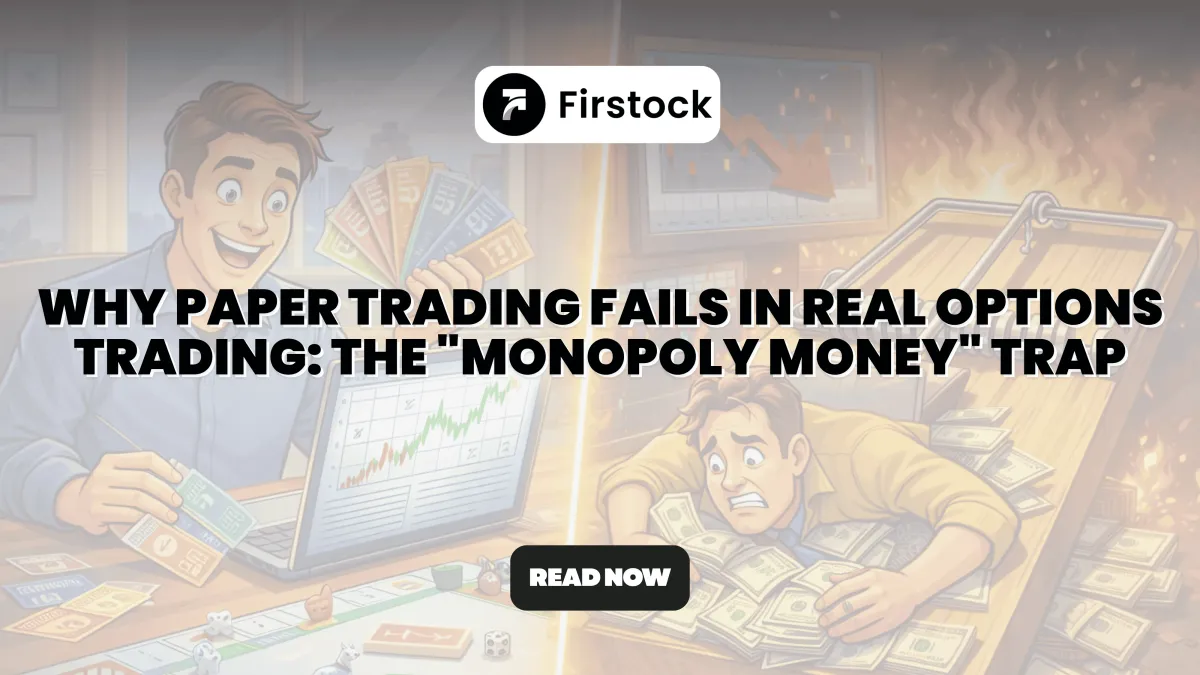
Why Paper Trading Fails in Real Options Trading: The "Monopoly Money" Trap
You’ve been paper trading for a month. Your virtual portfolio is up 50%. You feel like a market wizard, ready to deploy your hard-earned capital into Nifty or Bank Nifty options.
Stop right there.
While paper trading is an excellent tool for learning mechanics, it is often a terrible predictor of profitability. In fact, relying solely on paper trading results is one of the fastest ways to blow up a real account.
Why does this happen? Why does a strategy that prints millions on a simulator lose money in the live market? Here is the breakdown of why paper trading fails in real options trading.
1. The "Perfect Fill" Fantasy (Liquidity & Spreads)
In options trading, liquidity is everything. This is the biggest lie paper trading platforms tell you.
- Paper Scenario: You see a Nifty Call Option with a Bid of ₹100 and an Ask of ₹105. You place a Limit Order at ₹102.50 (the Mid-Price). The simulator instantly "fills" your order. You are in the trade.
- Real Life Scenario: You place a Limit Order at ₹102.50. The market makers ignore you. The price shoots up to ₹110. You chase it and buy at ₹112.
- Result: You entered ₹10 higher than your paper trade.
In the real world, you often have to cross the Bid-Ask Spread to get filled, especially in illiquid strikes. This "slippage" eats into your profits immediately, something simulators rarely account for.
2. The Psychology of "Skin in the Game"
What is paper trading in stock market? It is trading without consequences. When you lose ₹50,000 on a paper trading app, you might shrug and hit "Reset." When you lose ₹50,000 of your own savings, your heart races, your palms sweat, and your brain stops working rationally.
Real trading triggers two emotions that paper trading cannot simulate:
- Fear: In real trading, you might cut a winning trade too early because you are terrified the profit will vanish. On paper, you hold calmly until the target.
- Hope: In real trading, you might hold a losing position hoping it comes back (averaging down). On paper, you would have followed your stop-loss strictly.
The strategy didn't fail; the trader failed because of emotional pressure.
3. The Impact of Large Orders (Market Depth)
If you are paper trading with a large capital (e.g., ₹1 Crore virtual money), you might buy 5,000 quantities of an option contract.
- On Paper: The app fills 5,000 quantity instantly at the last traded price (LTP).
- In Reality: A buy order of 5,000 quantity might consume all the sellers at ₹100, then ₹101, then ₹102. Your average buy price goes up significantly. Plus, seeing a huge buy order might alert algos to push the price against you.
4. Ignoring the "Silent Killers": Costs & Decay
Paper trading often ignores the boring stuff:
- Brokerage & Taxes: In India, STT (Securities Transaction Tax), exchange turnover charges, and GST add up. A "break-even" trade on paper is actually a loss in real life once you deduct these.
- Theta Decay (Time Value): Some basic simulators don't accurately calculate real-time Theta decay during the day, making option buying look more profitable than it actually is.
The Myth of the "Guaranteed" Stop Loss
This is the most dangerous lesson paper trading teaches you: "My Stop Loss will protect me."
- Paper World: You buy a Call at ₹100. You set a Stop Loss (SL) at ₹90. The market crashes to ₹80. The simulator exits you comfortably at ₹90.
- Real World: The market crashes. The price jumps from ₹100 – ₹95 – ₹85 – ₹80 in a split second.
- Since the price "jumped" over your ₹90 trigger, your SL order might not get filled (if it was a Limit SL) or gets filled at ₹85 (Market SL).
- Result: You lost ₹15 per share instead of ₹10. This is called Slippage, and simulators almost never account for it during sudden spikes.
The "Revenge Trading" Spiral
Paper trading lacks the emotional trigger for Revenge Trading.
- Scenario: You take a loss of ₹10,000.
- On Paper: You think, "Oh well, bad trade. Let me analyze what went wrong." You remain logical.
- In Reality: You think, "I need to get that ₹10,000 back NOW before the market closes."
- You immediately enter a risky, unplanned trade with double quantity.
- You lose another ₹20,000.
- The Trap: Real money triggers the "Fight or Flight" response. Paper money triggers the "Learning" response. You cannot practice emotional control with fake money.
The "Last Traded Price" (LTP) Deception
Most basic paper trading apps execute your order at the LTP (Last Traded Price). This is misleading.
- The Reality:
- You Buy at the Ask (Sellers' Price).
- You Sell at the Bid (Buyers' Price).
- The Gap:
- LTP: ₹100
- Bid: ₹99.50 / Ask: ₹100.50
- If you Buy and immediately Sell in a simulator, you break even (0 loss).
- If you Buy and immediately Sell in reality, you lose ₹1.00 instantly (Buy at 100.50, Sell at 99.50).
- Impact: Over 100 trades, this "Spread Cost" can eat up 10-20% of your capital, which the simulator hides from you.
Transition Strategy: The "1-Lot" Rule
So, how do you move from Paper to Real without blowing up?
Step 1: The "Mechanics" Phase (1 Month)
Use paper trading only to learn the platform.
- How to add a strike price?
- How to place a Basket Order?
- How to exit a position?
- Goal: Muscle memory, not profit.
Step 2: The "Skin in the Game" Phase (3 Months)
Stop paper trading. Deposit a small amount (e.g., ₹20,000).
- Trade 1 Lot of Nifty (or even better, Nifty Bees or liquid stocks).
- Goal: Feel the pain of a ₹500 loss. If you can't handle a ₹500 loss calmly, you cannot handle a ₹50,000 loss.
Step 3: Scale Up
Only increase your lot size when you are profitable for 3 consecutive months on 1 Lot.
Summary: How to Use Paper Trading Correctly
Don't ditch paper trading entirely. Just use it for the right purpose:
- Use it to learn the software: Learn how to place Stop-Loss Limit orders vs. Market orders.
- Use it for logic checks: Does your strategy logic make sense?
- Do NOT use it for P&L validation: Never assume a 20% return on paper means you will get 20% in reality.
The Solution: Transition from paper trading to "One Lot" Trading. Trade with just one lot of Nifty or a low-value stock. The profit won't be huge, but the emotions will be real. That is the only way to truly learn.
FAQs
1. Is paper trading completely useless?
No. It is excellent for testing systems and logic. For example, if you want to see if a "Moving Average Crossover" strategy works historically, paper trading is great. Just don't use it to test your psychology.
2. Which is the best paper trading app for Indian markets?
Popular options include Neostox, Sensibull (Virtual Portfolio), and Opstra. These platforms allow you to trade Nifty/Bank Nifty options with virtual cash. Sensibull is particularly good as it accounts for real-time option chain data.
3. Does paper trading account for dividends and corporate actions?
Most simple simulators do not. In real options trading, if you hold a "Deep ITM Call" and the stock declares a dividend, the option price will drop overnight. Simulators might miss this adjustment, showing you wrong profit.
4. Why do I make money on paper but lose in real life?
Because on paper, you hold winning trades longer (no fear) and cut losing trades faster (no hope). In real life, you cut winners early (fear of reversal) and hold losers too long (hope for recovery). It is purely a psychological gap.
5. Should I paper trade for 6 months before starting?
No. 1-2 months is enough to learn the basics. If you paper trade for too long, you build a false sense of confidence. The sooner you trade with real (even if small) money, the faster you learn risk management.
Disclaimer: The content should not be construed as investment, trading, or personal financial advice.This blog is for educational purposes only.